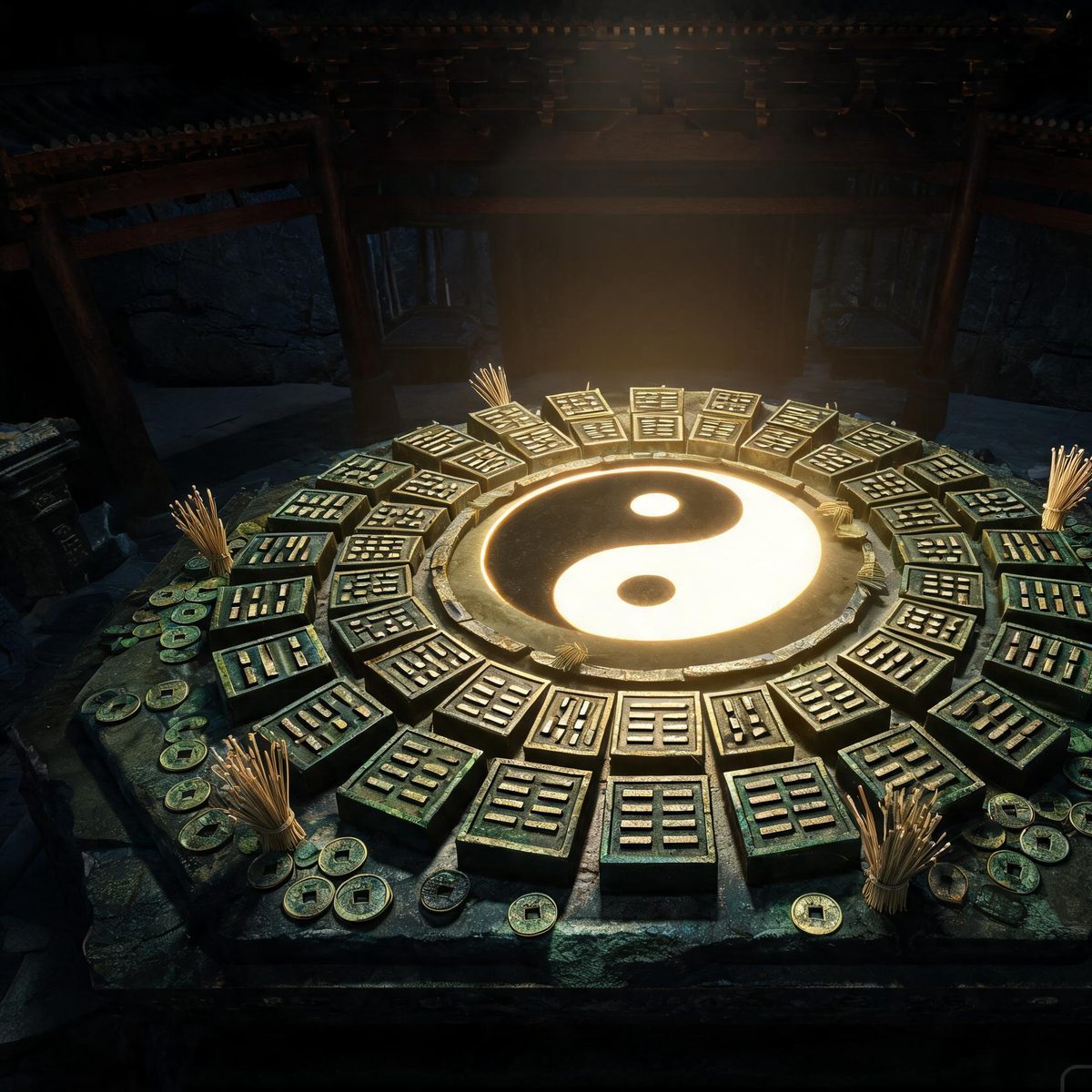
Honestly, when I first picked up the I Ching — the Zhou Yi, the Book of Changes — I thought the same thing you're probably thinking. Three thousand years old? What does a Bronze Age oracle have to say about whether I should take that job offer or not?
But here's what's funny. The more you use it, the more you realize it's not "old." It's fundamental. It's like gravity — Newton figured it out three hundred years ago, but if you jump off a building it still works. The I Ching is about the same kind of fundamentals: the patterns of change, the rhythm of timing, the art of knowing when to advance and when to hold back. That stuff doesn't expire.
Most people don't know this, but the I Ching wasn't originally some mystical text locked away in a temple. During the Shang and Zhou dynasties — we're talking 1100 BC — kings used it to decide whether to go to war. Farmers used it to decide when to plant. Regular people used it for marriage decisions. It was practical. It was a tool. The Confucian scholars later wrapped it in so many layers of philosophy that regular people got scared off. But underneath all that, it's still a decision-making device. And that's what I want to show you.
The mechanics are surprisingly simple. You take three identical coins — any coins. Three pennies, three quarters, three yuan coins, whatever. You hold them in your hand, focus on a specific question, and throw them six times. Each throw gives you one line — either solid yang or broken yin. Six lines stacked together form a hexagram. Sixty-four possible hexagrams. That's it.
But here's the part most guides skip: the question matters more than the coins. You can't ask "what will my life be like?" That's too broad. The I Ching isn't a fortune-telling machine — it's a situation analyzer. Ask something specific. "Should I keep doing this job or start looking?" "Is this partnership worth pursuing or should I walk away?" "Is now the right time to launch this project?" The more precise your question, the more useful the answer.
The actual throwing works like this: throw three coins. Count heads. Three heads is "old yang" — draw a solid line but mark it with a circle, because it's about to flip to broken. Three tails is "old yin" — draw a broken line with an X, because it's about to flip to solid. Two heads and one tail is "young yang" — solid line, stable. Two tails and one head is "young yin" — broken line, stable.
Do this six times, drawing from the bottom up. The bottom line is line one, the top is line six. When you're done, you have two hexagrams: the "original" (what you threw) and the "transformed" (after changing old yang to yin and old yin to yang). The original hexagram describes your current situation. The transformed one shows where things are heading. The lines that changed — the old yang and old yin positions — are where the action is.
The old masters have a saying: beginners fail at the I Ching because they try to understand everything at once. There are 64 hexagrams, and each one has a judgment, line statements, image commentary, and more. If you try to digest all of it, you'll be lost for three years and never actually use it.
My advice — for daily decisions, you only need three things:
First, the hexagram name. This alone gives you half the answer. Say you asked "should I push this project forward now?" and you got Hexagram 5 — Xu, which means "Waiting." The image is clouds gathering above but rain hasn't fallen yet. Should you charge ahead? The name already told you: conditions are almost ready, but not quite. Wait.
Second, the Judgment. Every hexagram has a short core statement, traditionally attributed to King Wen. Hexagram 1, Qian — the Creative — has four characters: yuan, heng, li, zhen. Originating. Pervading. Benefiting. Persevering. If you asked about starting a business and got Qian, the Judgment is saying: this has creative potential, it can work, but you have to do it right.
Third, the changing lines. If any of your throws produced old yang or old yin, those specific line statements are your personalized advice. No changing lines? Just read the Judgment and you're done.
You know what I think is the real genius of the I Ching? It's not about whether it's "accurate." It's that it forces you to look at your problem from an angle you wouldn't have chosen. You came in thinking "push or pull?" and the hexagram reframes it as "is the timing right?" That perspective shift alone is worth more than any yes-or-no answer.
Let me tell you about a few times I put this to the test, so you can see how it actually plays out in practice.
I was choosing between two business partners once. Partner A had better terms but something felt off. Partner B was solid but the deal was less exciting. I threw the coins and got Hexagram 10 — Lu, "Treading." The image is stepping on a tiger's tail. The Judgment says "the tiger does not bite. Success." But the core meaning of Lu is: proceed extremely carefully. The message was clear — Partner A could work, but only if I was meticulous about the details. I chose A but wrote a very tight contract. Sure enough, a few wrinkles came up, but the contract caught them.
Another time I asked whether to expand my team that year. Got Hexagram 9 — Xiao Chu, "Small Accumulation." Wind above, heaven below. Looks impressive but the actual power isn't there yet. The Judgment: "dense clouds, no rain." I understood immediately — looks like we're ready to grow, but the resources aren't actually in place. I postponed the expansion six months. Turned out to be exactly right — if I'd expanded when I originally wanted to, cash flow would've been a disaster.
The funniest one: I asked whether to go back into business with an old friend. Got Hexagram 6 — Song, "Conflict." The Judgment literally says "it does not further one to cross the great water" — don't undertake major ventures. I thought: do I even need to interpret this? I passed. Later I found out the guy was in a legal battle with his current business partners. The I Ching didn't predict the lawsuit — but it read the energy of the situation correctly.
A lot of people use the I Ching wrong. They treat it like a fortune cookie dispenser — toss coins, get a command, execute. That's not how it works.
In my experience, the best way to use the I Ching is as a mirror. Deep down, you usually know what you should do. You're just not ready to admit it. The I Ching's job is to use three thousand years of wisdom to flip your own answer around so you can finally see it. It doesn't say "do this." It says "this is the nature of your situation, and these are the kinds of actions that work in this kind of situation." Then you decide.
One more thing: don't ask the same question over and over. The ancient text itself warns about this: "The first consultation brings insight. The second and third show disrespect. When there is disrespect, insight stops coming." My interpretation: if you don't trust the first answer, you already have a preference. In that case, stop asking and just go with your gut.
If you want to go deeper — see how your Bazi chart interacts with the hexagrams, how your elemental balance affects which answers you get — the masters at Tianling Pavilion can help with that. But for everyday decisions? Three coins and a hexagram reference. That's really all you need.
Five masters. Ziwei. Bazi. I Ching. One reading — totally free.
Get Your Free Destiny Reading