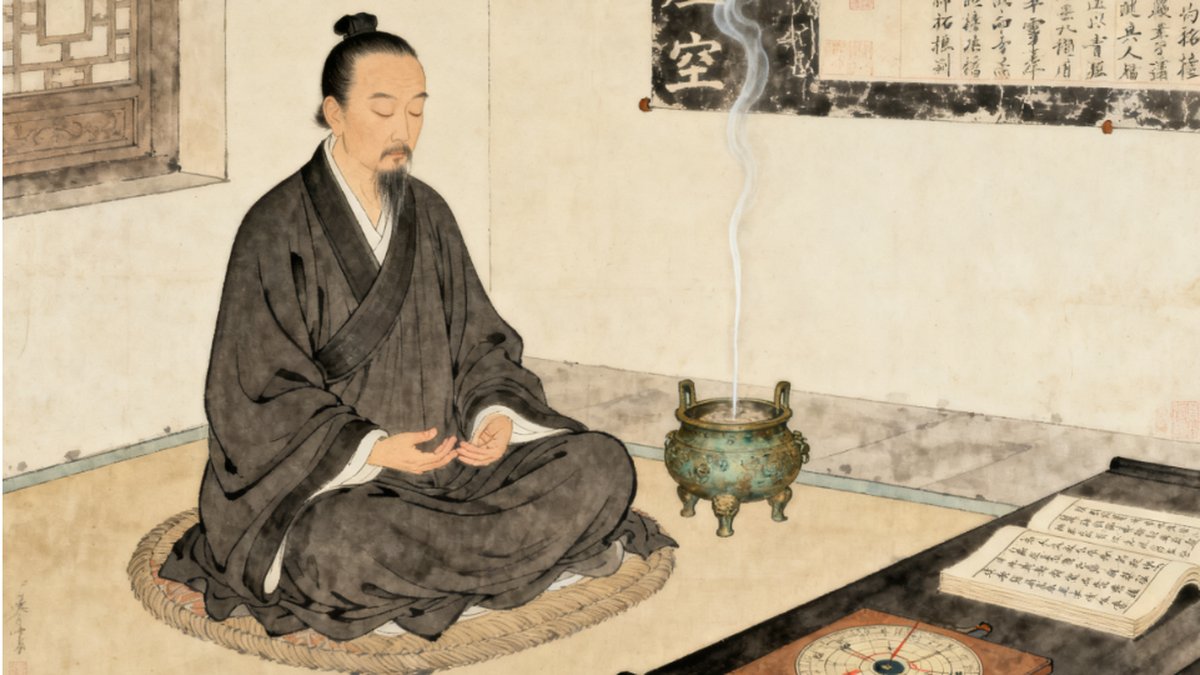
Long before Western psychologists coined the term lucid dreaming, Taoist adepts practiced meng lian — dream cultivation — a sophisticated system for maintaining conscious awareness during sleep. Unlike Western lucid dreaming which often focuses on controlling dream content for entertainment, Taoist dream yoga pursues lucidity as a spiritual practice: using the dream state to explore the nature of consciousness itself.\n\nThe foundational text of Taoist dream practice is the Zhou Gong Dream Dictionary, but the advanced practices were transmitted orally from master to student for centuries. These techniques share remarkable similarities with Tibetan Dream Yoga, suggesting a common origin in the shamanic traditions of Central Asia.
Gate One: Recognition. The practitioner trains to recognize the dream state while within it. The primary technique is the daytime reality check: throughout the day, ask yourself 'Am I dreaming?' and perform a test — try to push your finger through your palm, read text twice to see if it changes, or check whether light switches work. After weeks of daily practice, the habit carries into dreams, triggering lucidity.\n\nGate Two: Stabilization. Achieving lucidity often causes the dream to collapse as excitement floods the brain with waking-state neurochemistry. The Taoist method: immediately upon becoming lucid, rub your dream hands together and focus on the sensory detail. This grounds consciousness within the dream and extends lucid duration from seconds to minutes.\n\nGate Three: Transformation. Once stable in the lucid dream, the practitioner can engage with dream content consciously. The Taoist approach is not to control or dominate the dream but to ask questions: 'What do you represent?' to dream figures, 'What are you teaching me?' to dream environments. Dream figures often provide surprisingly profound answers because they are accessing parts of your own consciousness that waking awareness cannot reach.
Zhou Gong's protocol combines intention-setting with symbol recognition. Before sleep, select one dream symbol from your journal that has appeared at least three times. Mentally rehearse seeing this symbol and recognizing it as a dream sign. When the symbol appears in a dream, the recognition triggers lucidity.\n\nThe protocol also recommends sleeping in the 'tiger posture' — lying on your right side with your right hand under your cheek and left hand on your left thigh. This posture, also used in Tibetan dream yoga, is believed to balance the energy channels in ways that support conscious dreaming. Modern research confirms that sleeping position affects dream content and recall, though the mechanisms remain under investigation.
Five legendary masters. Three ancient arts. One complete reading. Completely free.
Get Your Free Destiny Reading