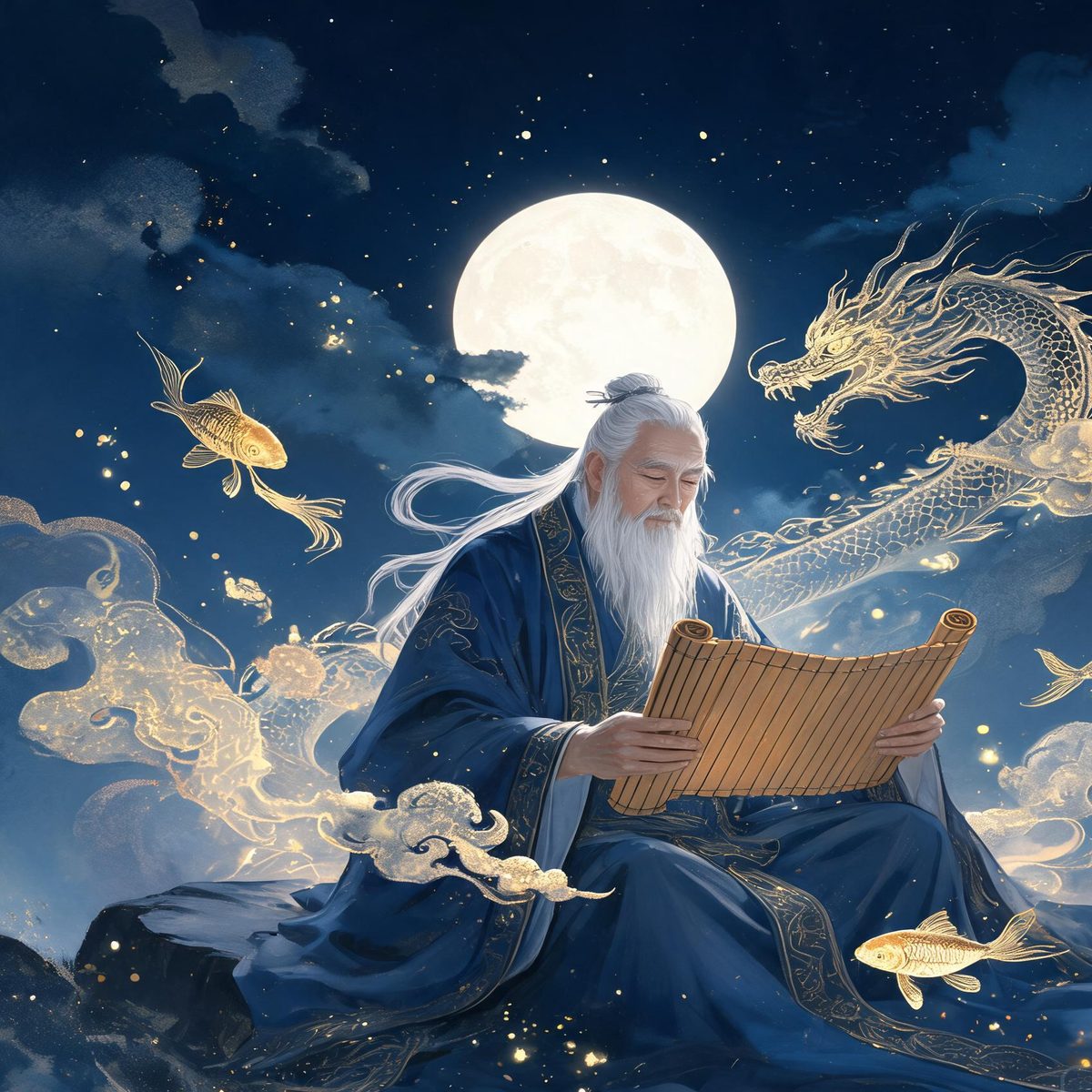
Zhou Gong Dream Interpretation: How Ancient Wisdom Decodes Your Dreams
For over three thousand years, the Chinese have turned to one book above all others to understand their dreams: the Zhou Gong Jie Meng (周公解梦) — the Dream Dictionary of the Duke of Zhou. But what makes this ancient text so enduring, and how can you use its wisdom today?
Who Was Zhou Gong?
Zhou Gong (周公), also known as the Duke of Zhou, was a legendary statesman and sage of the Western Zhou Dynasty (1046–771 BC). Confucius himself revered him as a paragon of virtue and wisdom. According to tradition, Zhou Gong received divine understanding of dreams, compiling his knowledge into a systematic framework that would guide dreamers for millennia.
In Chinese culture, dreams are not random neural firings — they are letters from the soul, messages from ancestors, or omens from the cosmos. Zhou Gong taught that every symbol in a dream carries meaning, and that meaning shifts based on context, emotion, and the dreamer's waking life.
The Five Categories of Dreams
Traditional Zhou Gong dream interpretation classifies dreams into five fundamental types:
- Direct Dreams (直梦) — Events that will literally happen as dreamed. If you dream of a visitor arriving, someone may indeed come the next day.
- Symbolic Dreams (象梦) — Dreams where objects and events carry symbolic meaning. Dreaming of fish suggests abundance; dreaming of snakes may indicate hidden threats or transformation.
- Inverse Dreams (反梦) — Dreams where the opposite occurs in waking life. A dream of death may portend birth or renewal; a dream of wealth may warn of loss.
- Body Dreams (体梦) — Dreams triggered by physical sensations during sleep. Feeling cold in a dream may reflect actual room temperature; dreaming of thirst may indicate dehydration.
- Spirit Dreams (魂梦) — Dreams believed to come from the spirit world, ancestors, or deities. These often feel more vivid and carry profound emotional weight.
Common Dream Symbols and Their Meanings
Zhou Gong's dictionary catalogs hundreds of symbols. Here are some of the most frequently encountered:
Animals
- Dragon (龙) — Supreme fortune. Power, authority, and spiritual elevation. One of the most auspicious dream symbols.
- Snake (蛇) — Duality. Can represent wisdom and transformation, or hidden danger and betrayal. Context is crucial.
- Fish (鱼) — Abundance and prosperity. Dreaming of catching fish suggests financial gain ahead.
- Horse (马) — Freedom and career advancement. A galloping horse signals rapid progress.
- Phoenix (凤凰) — Rebirth and feminine power. Often signals a major positive life transition.
Natural Elements
- Water (水) — Emotion and the subconscious. Clear water = clarity; murky water = confusion; flooding = emotional overwhelm.
- Fire (火) — Passion and transformation. Controlled fire suggests creative energy; wildfire warns of uncontrolled anger.
- Mountains (山) — Obstacles or ambitions. Climbing = overcoming challenges; falling = setbacks ahead.
- Wind (风) — Change and news. A gentle breeze brings good tidings; a storm warns of turmoil.
Life Events
- Flying (飞行) — Liberation from constraints. A desire for freedom or spiritual transcendence.
- Falling (坠落) — Loss of control or anxiety about a situation. Often reflects fear of failure.
- Teeth Falling Out (掉牙) — Anxiety about aging, appearance, or communication. In Chinese tradition, may also signal worry about family elders.
- Being Chased (被追) — Avoidance. You are running from something in your waking life — a decision, a confrontation, or a truth.
Pro tip: The same symbol can mean different things depending on your emotional state in the dream. A snake that frightens you differs from one you observe calmly. Always note how you felt.
How to Interpret Your Own Dreams
- Record immediately. Keep a notebook by your bed. Dreams fade within minutes of waking.
- List every symbol. People, objects, animals, colors, weather — everything matters.
- Note your emotions. Fear, joy, confusion, and calm each shift the interpretation.
- Check the Zhou Gong dictionary. Look up each symbol. Cross-reference multiple meanings.
- Connect to waking life. What situation, decision, or relationship might this dream be addressing?
- Synthesize, don't isolate. A single symbol means little. The pattern across all symbols tells the story.
Try our AI-powered Zhou Gong dream decoder. Enter any dream and receive a personalized interpretation synthesized from the ancient dictionary — for free. Decode your dream →